Our mission
To keep the lamps lit on Catherine Street, and the children at their books.
BASH TRUST exists to fund the necessary works on the Plymouth Hebrew Congregation's buildings, and to support the religious education of the families who worship there. Everything we do is a footnote to that single sentence.
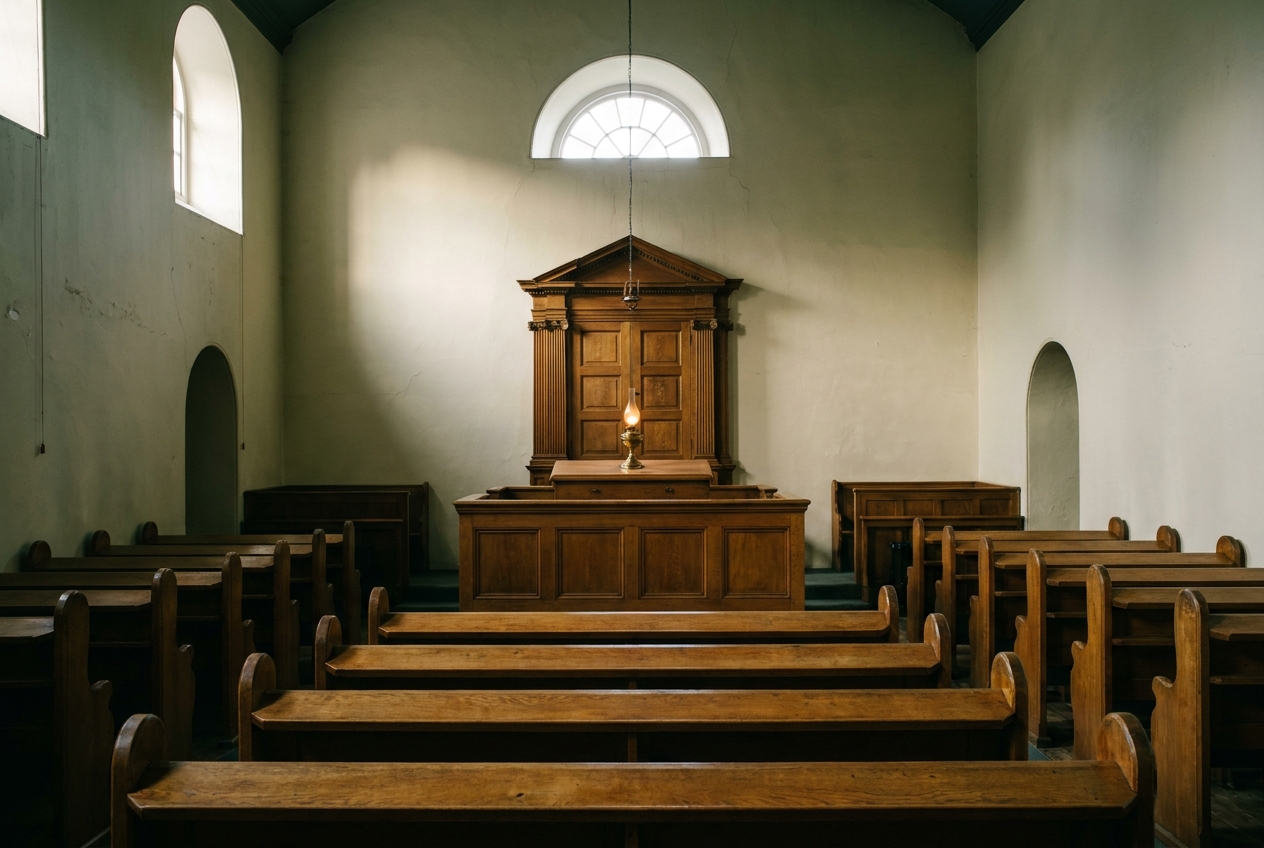
Most charities of our size and shape would, by 2026, have rewritten their mission half a dozen times. They would have added language about "place-making" and "thriving communities" and "the wider impact of heritage on wellbeing". We have not done that. The deed of 1963 is unaltered, and it is the only thing the trustees are empowered to act under. So our mission, in plain words, is the one written by people who are now gone, and we are the temporary stewards of it.
Our values, written down quietly.
We do not have a values poster on a wall anywhere. There would not, in any case, be a wall to put it on. But four ideas govern the way the trustees take decisions.
- Restraint. A grant is justified by need, not by ambition. If the building does not need it this year, the money waits in the endowment.
- Continuity. The room has held prayers continuously since 1762. Continuity is the chief good we serve.
- Honesty. Every grant is itemised in the annual report. Every refusal is, on request, explained to the applicant.
- Cooperation. We work with the wardens, the architect, Historic England, and Jewish Heritage UK. None of this work is done by us alone.
Theory of change
A small chain that connects an endowment to a Friday evening.
We are too small for elaborate logic models. Ours is three steps long.
Inputs
A steady endowment.
The capital settled in 1963, held conservatively. Its income, plus a small flow of donations and Gift Aid where individuals route their gifts that way, becomes the year's grant budget.
Activities
Grants in three categories.
Fabric, education, heritage. Each application is reviewed against the deed and against the architect's quinquennial report. Awards are made by the two trustees, on the record.
Outcome
A building that opens its doors.
The roof is sound. The bimah is sound. The children have a teacher and a primer. The Friday evening service happens. That is the whole outcome we measure.
We do not claim more than this chain delivers. We do not, for example, claim that we "build community" — the community builds itself, and has done since long before we existed.
The things we have not done.
It is fashionable, in writing about a charity, to claim only successes. We have not always succeeded.
In the winter of 2017 we agreed, after a long deliberation, to fund the installation of a small accessible ramp at the synagogue's main entrance. The work was carried out by a contractor in good standing. Within eighteen months the ramp had begun to lift away from the side wall, and an interim repair was required. The full remedial work, which we paid for a second time, was not completed until late 2019. The trustees concluded — and the annual report for 2019–20 says so — that we had hurried the procurement and not consulted closely enough with the synagogue's architect at the design stage. We made a small change to our grant-making policy as a result: works on the listed fabric are now always reviewed by the architect before payment is released, regardless of the value of the contract. That review costs a little time. It is, on balance, worth it.
It is also right to say that there are years in which we have done very little at all. The accounts for the year ending 5 April 2025 show expenditure of £0. We did not, that year, fund any works, because nothing fell due that justified an outlay. We could have invented a project. We did not. The endowment is not there to be spent for its own sake.
What an honest annual report looks like
It looks, often, like a single short paragraph on a single page of A5. The trustees believe this is a feature, not a defect. A small charity that writes long reports is, usually, a small charity that has lost its way.
Why we are not bigger.
We are sometimes asked, by friends in the wider sector, whether we have considered expanding — to fund similar work at other small synagogues, or to take on a broader remit in Jewish heritage. The answer is a settled no. The deed restricts our work to the Plymouth Hebrew Congregation's buildings. We could, in principle, apply to the Charity Commission for a scheme to vary that purpose. We have considered it and decided against it on three separate occasions. The deed names the building it names. The discipline of staying within those words is, we think, what allows us to do this one small thing carefully.
Where we go from here.
Two pieces of work occupy the next twelve months. The first is the Bimah Restoration Appeal, which is described in detail on our news pages and on the support page. The second is the slow re-housing of the synagogue's paper archive, which has been a project running quietly under the Heritage programme since 2024. We will, as always, report on both in the next annual report, and we will not announce anything we have not done.
Read the deed in action.
Our grant programmes set out, in plain words, where the year's money goes.
See the grant programmes