Essay · 2 March 2026
Two hundred and sixty years on Catherine Street.
By Naomi Levy, Senior Warden, Plymouth Hebrew Congregation ·
Essay · 2 March 2026
By Naomi Levy, Senior Warden, Plymouth Hebrew Congregation ·
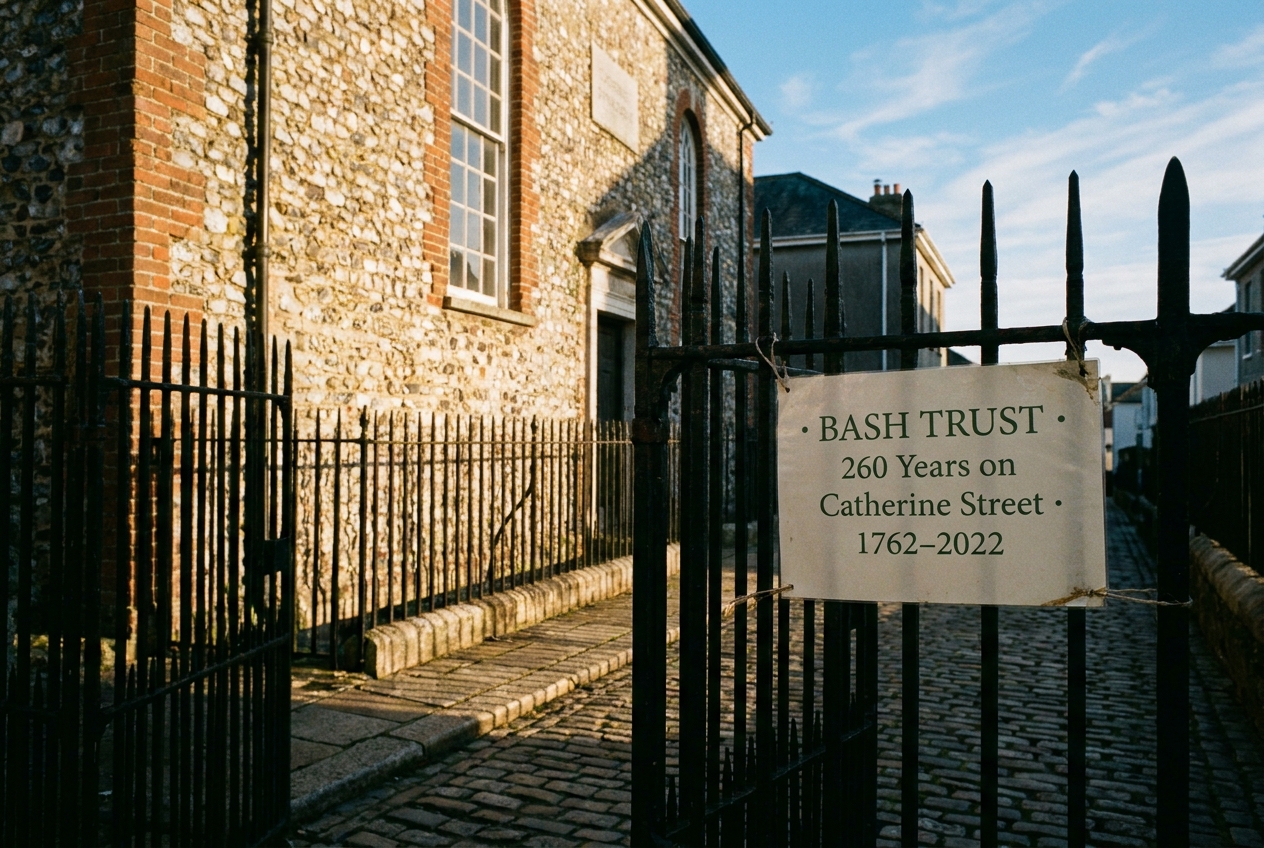
On the twenty-sixth of August 1762 the Catherine Street synagogue was consecrated. The wardens' first minute book, which has survived all the things one might expect it not to have survived, records that the day was warm, that a small crowd gathered outside the building before the service, and that the meeting concluded — politely — at "eleven of the clock". I have always liked that last detail. The wardens of 1762 wanted us to know, two and a half centuries later, that they had not run over time.
I have been the senior warden of the congregation since 2019, which makes me, by the long count of this building, an extremely junior figure. The names of my predecessors fill the inside cover of three minute books. They include a tea merchant, a naval supplier, a draper, a glazier, a watchmaker, and a doctor whose practice operated out of a back room on Looe Street. I am a retired secondary-school deputy head. There is nothing remarkable about that change of professions, and yet I think it tells you most of what is true about a small congregation: it does not need remarkable people, and it cannot afford to wait for them.
A building is a long, slow argument between weather and people, and people, mostly, win.
What does it mean for a synagogue to be 264 years old this summer? Materially, very little. The slates have been replaced a few times. The plaster on the south wall is, I am told, mostly Edwardian. The timber bimah, on which BASH TRUST has now opened an appeal, is original, but I am not allowed to claim that any one piece of it has not had a peg replaced or a corner planed in the long course of being in continual use. Buildings of this age survive precisely because they are not preserved as museums. They are kept up. That is a different word, and a more honest one.
Plymouth's Jewish community has never been large. At the time of the 1841 census there were perhaps 150 of us in the city. At the 1911 census, perhaps 230. After the Plymouth Blitz of 1941 the number fell sharply, and through the long decades of post-war re-housing it fell again. By the 1980s a regular Shabbat minyan was no longer guaranteed. We have, through the work of three remarkable wardens and a small handful of younger members who have moved back from London, climbed slowly out of that low water. We are still small. We are not in danger.
I mention all this because anniversary essays of this kind have a tendency to pretend that a small congregation is a thriving one. We are not thriving. We are surviving, which is, on the whole, harder and more interesting. We are surviving with patience and with the support of a network of friends, including the trustees of BASH TRUST, who keep the roof on for us, who pay the rabbi's railway ticket from Paddington, and who, on the rare occasion when an internal wall cracks, send their architect down to look at it within the week.
In the early summer of 2022, on the sixtieth anniversary of the founding of the State of Israel — which is not the anniversary we were marking, but which fell, for various reasons, in the same fortnight — a woman in her late seventies came to a Friday-evening service for the first time in thirty years. Her name is Margaret Stein, and she had come back to Plymouth, after a long career in London, to be closer to her sister. She wrote, later that year, a short piece for our quarterly newsletter, which the trustees of BASH TRUST republished on their website. Margaret has been at almost every Shabbat since. She brings shortbread. She is patient with my Hebrew, which is not what it used to be.
In the autumn of 2023 a young couple, Daniel and Ruth, came to a Heritage Open Days tour with their daughter, who was then six. The daughter asked, of the bimah, whether you were allowed to stand on it. The wardens, who are not usually permitted to encourage children to stand on listed timber furniture, encouraged her to stand on it. She is now eight, and she helps Helena Solomon set out the prayer books on the school's class visits. None of this is in the Charity Commission record. None of it is in the architect's quinquennial. All of it, though, is what 264 years on Catherine Street looks like.
This year we will run our two Heritage Open Days as usual, in September and in March. We will receive perhaps 280 visitors between the two. We will, with the support of BASH TRUST, begin work on the bimah in August. We will continue to teach our small cheder on Sunday mornings, with Eli Mendelson and with the patience of three children who are very young and one who is not. We will mark our anniversary, very quietly, on the twenty-sixth of August, with a service that will conclude, the wardens have decided, at "eleven of the clock". That much, at least, we can promise.
Naomi Levy is the Senior Warden of the Plymouth Hebrew Congregation. She is not a trustee of BASH TRUST. She writes here in her capacity as the principal point of liaison between the congregation and the Trust.