Essay · 14 November 2025
Bringing the archive into the light.
By Eli Mendelson, Archive Lead, Plymouth Hebrew Congregation ·
Essay · 14 November 2025
By Eli Mendelson, Archive Lead, Plymouth Hebrew Congregation ·
In the upstairs room above the synagogue's small kitchen, behind a door that nobody locks because the door itself is a hundred and forty years old and would not survive being locked, there is a cupboard. Until last summer that cupboard contained a slightly chaotic collection of about thirty cardboard boxes, several large brown envelopes, three loose-leaf binders from the early 1990s, a small velvet bag containing seven keys whose locks have all long since been replaced, and the entire paper record of the Plymouth Hebrew Congregation from approximately 1782 to the present day. The cupboard, you will not be surprised to learn, was not lined.
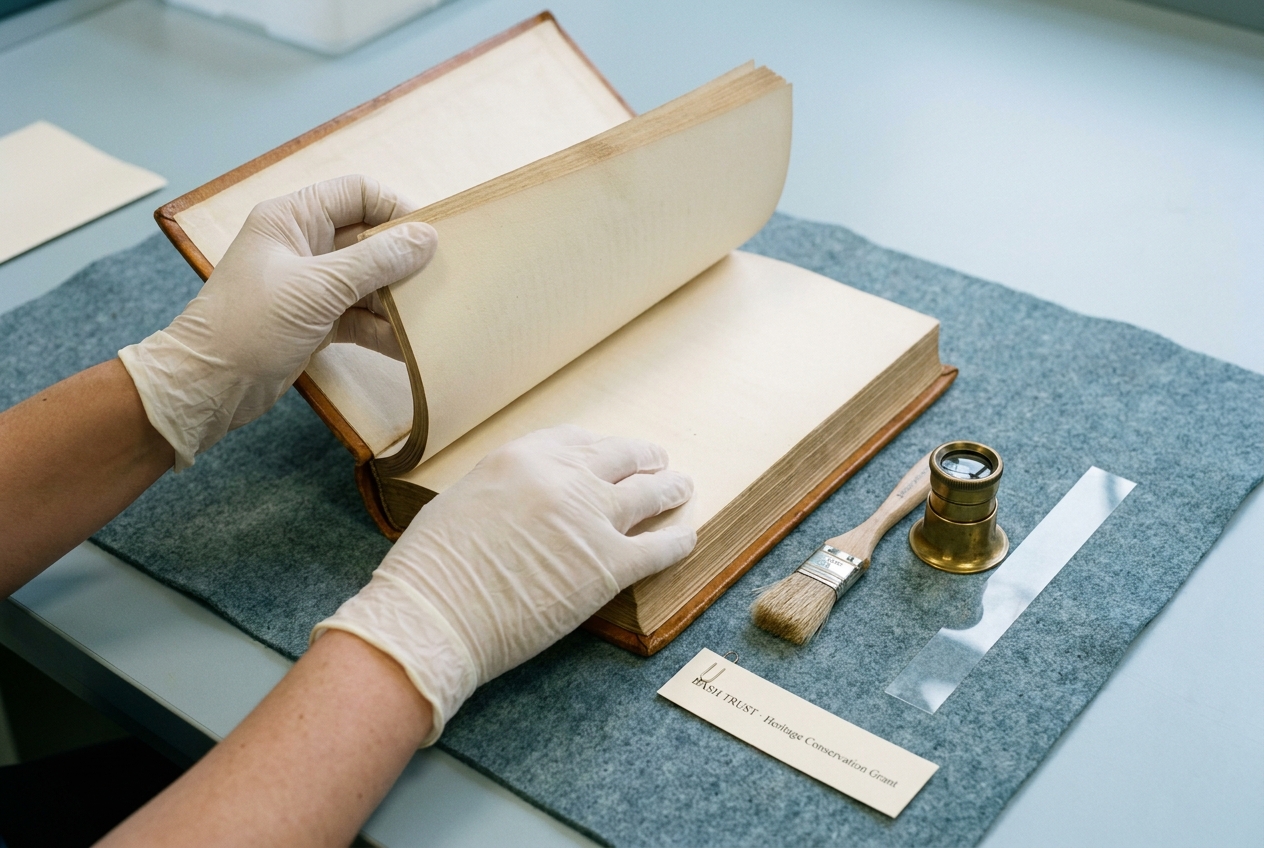
I am a history teacher at a secondary school in Plymouth and I spend my Tuesday evenings, two of them a month, opening boxes from that cupboard and slowly, carefully, putting their contents into things that are not cardboard. The work is funded under the Heritage Conservation programme of BASH TRUST. The grant for this calendar year is £1,180, and it pays for archival folders, melinex sleeves, acid-free tape, the hire of a conservator from Exeter for two days, and the small electric humidifier we now run, between November and March, in the corner of the archive room.
This is, broadly, what we have.
The 1941 minute book is, in a way I cannot quite explain, the calmest thing I have ever read about being bombed.
An archive volunteer does not, on the whole, "discover" things. The wardens of two hundred and sixty years' worth of Tuesdays already knew, when they wrote them down, what they were writing. The work is to keep the writing readable for the next two hundred and sixty years' worth of Tuesdays. That involves, mostly, three actions: removing the paper from any container that is degrading; placing it into a container that is not degrading; and producing a short index entry so that someone who comes after me can find it.
The most valuable thing the BASH TRUST grant has paid for is the conservator, who comes down from Exeter twice a year to assess what we have done and to suggest where we have gone wrong. Her name is Dr Eleanor Pascoe and she is the only person I have ever met who will look at a piece of nineteenth-century paper and refer to it, without irony, as a person.
In July of this year we had the first school visit specifically to the archive. Helena Solomon, who runs the schools programme, brought a group of nine children from a primary school on Mannamead Road. They were ten years old. They were quiet — quieter than I had expected.
They handled, with cotton gloves, a single page of the 1818 minute book. They looked at a sketch of the building from 1874, drawn by the architect's apprentice. They were shown, but did not touch, the wardens' note from 23 March 1941 in which the secretary observes, in a sentence I cannot now write without thinking about, that "the windows held". The conversation afterwards was, I thought, the best lesson I have ever delivered in twenty-one years of teaching, and I did not actually deliver it. The room delivered it.
By the end of 2026 we expect to have re-housed the school exercise books, the marriage register, and the entire wardens' correspondence from 1939 to 1948. By the end of 2027 we hope to have the photographs catalogued. The minute books — all three of them — will be re-bound, professionally, by a conservator in Bristol, during 2028 or 2029, depending on the grant cycle. The Devon Record Office has agreed to take the archive on long loan once it is properly catalogued, which will mean it can be consulted by researchers under proper conditions. That is, I think, the right home for it. The cupboard above the kitchen will be empty. The keys, I will keep.
Eli Mendelson is the archive lead at the Plymouth Hebrew Congregation. He is not a trustee of BASH TRUST. He teaches history at a Plymouth secondary school.
The Heritage Conservation programme is funded entirely by donations and the endowment's income.
Support the archive work